







Texas Instruments LM5156EVM-BST Controller Evaluation Module (EVM)
Texas Instruments LM5156EVM-BST Controller Evaluation Module (EVM) showcases the features and performance of the LM5156. The LM5156 is a wide-input, non-synchronous boost controller. The standard configuration is designed to provide a regulated output of 12V at 3A from an input of 3V to 12V, switching at 440kHz. This Texas Instruments LM5156EVM-BST evaluation module is designed for easy configuration, enabling users to evaluate many different applications on the same module. Functionality includes external clock synchronization, enabling spread spectrum oscillator dithering, programmable slope compensation, adjustable soft-start, programmable cycle-by-cycle current limit, and output over-voltage protection.
Features
- 3V to 12V input voltage range
- 12V at 3A output voltage
- 440kHz switching frequency
- Internal spread-spectrum operation
Required Equipment
- Power supply with an input voltage source (VIN) should be a variable supply capable of 0V to 20V and source at least 15A
- Multi-meters
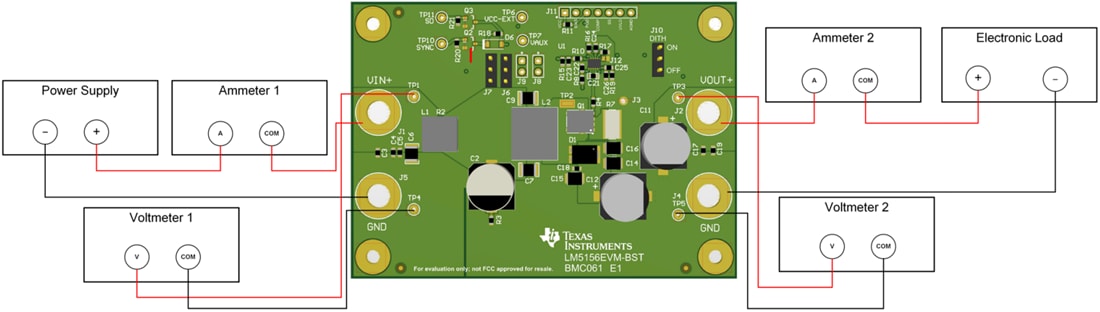
- Voltmeter 1: Input voltage connected from VIN to VIN-
- Voltmeter 2: Output voltage connected from VOUT to GND
- Ammeter 1: Input current must be able to handle 15A (Shunt resistor can be used as needed)
- Ammeter 2: Output current must be able to handle 3A (Shunt resistor can be used as needed)
- The electronic load should be constant resistance (CR) or constant current (CC) capable and should safely handle 3A at 12V
- Oscilloscope with 20MHz bandwidth and AC coupling
- Measure the output voltage ripple directly across an output capacitor with a short ground lead
- It is not recommended to use a long-leaded ground connection due to the possibility of noise being coupled into the signal
- To measure other waveforms, adjust the oscilloscope as needed
Test Setup
Related Product

Texas Instruments LM5156x/LM5156x-Q1 Boost Controller
Wide input range (3.5V to 60V) controller that uses peak current mode control.
Paskelbta: 2020-08-03
| Atnaujinta: 2024-07-24